ChatGPT ads don’t have one fixed price. In the United States, OpenAI’s standard minimum daily campaign budget is $25, and it recommends starting with a $3–$5 maximum bid per click for cost-per-click campaigns. That bid is not a guaranteed price: actual costs depend on the auction and your campaign settings. Daily spending can also exceed your selected daily budget on individual days. We recommend starting with at least $500, especially now to take advantage of the $500 ad offer.
How Much Do ChatGPT Ads Cost? Pricing, Bidding, and Who Should Advertise
Pricing and platform details checked November 4, 2026.
If you’re considering advertising in ChatGPT, the more useful question is not just “How much does a click cost?” It’s “Can the people who click become customers at a cost that makes sense for my business?” Here’s how the platform charges advertisers, how its bidding works, and how to decide whether it’s worth testing.
How much do ChatGPT ads cost?
The standard minimum daily budget for a U.S. campaign is $25, but your actual cost per click or conversion isn’t fixed. OpenAI offers both impression-based and click-based billing, and the amount you spend depends on your budget, bids, campaign settings, and delivery. Minimum budgets vary by market and currency.
Here are the main ways to think about cost:
•Cost per click (CPC): You pay for valid clicks. For click campaigns, OpenAI suggests a starting maximum bid of $3–$5 per click. That is a bid recommendation, not a promise that every click will cost that amount.
•Cost per thousand impressions (CPM): You pay based on how often your ad is shown. CPM expresses the cost of 1,000 impressions. OpenAI does not publish one fixed CPM that applies to every campaign.
•Cost per acquisition (CPA): This is a performance metric: ad spend divided by the number of attributed purchases, leads, or other desired actions. A conversion-focused objective does not necessarily mean you pay per conversion.
For conversion-optimized campaigns, OpenAI says advertisers can choose billing based on impressions or valid clicks. The system can optimize toward a purchase or another supported action, but the charge is tied to the selected billing method—not automatically to each purchase.
Is $25 a day the most I can spend?
No. A $25 daily budget is an average budget, not a strict $25 daily spending cap. With an unchanged daily budget, OpenAI says a campaign may spend up to twice that amount on an individual day, while the applicable seven-day limit is seven times the daily budget.
For example, if you set a $25 daily budget and leave it unchanged for a full Sunday-to-Saturday budget week, the campaign could spend up to $50 on a particular day and up to $175 across that week. It could also spend less. If you change the budget during the week, OpenAI applies different, prorated limits, so review the limits shown in Ads Manager before launching or editing a campaign.
The $25 figure is a minimum budget setting, not a guarantee that the campaign will spend $25 every day. Some fixed-bid settings may also require a higher daily budget.
Does the $8 CPC in Ahrefs tell me what ChatGPT ads cost?
No. Ahrefs’ keyword CPC is an estimate for bidding on a keyword in Google Ads, not the cost of an ad placement inside ChatGPT. For example, an $8 CPC shown for the keyword “ChatGPT ads” relates to Google Ads keyword research. It should not be used as a ChatGPT advertising price.
How do ChatGPT ads work?
ChatGPT ads are paid placements that can appear alongside a ChatGPT conversation when OpenAI’s system considers them relevant. Advertisers create campaigns in Ads Manager, choose a goal and budget, provide ad creative and a landing page, and submit their ads for review.
A standard ad appears below a response and includes the advertiser’s name, headline, description, image, and a link. For example, someone comparing running shoes might see a relevant ad from a sporting goods brand. That’s an illustration of how a placement could work, not a guarantee that a specific prompt will trigger an ad.
OpenAI considers signals such as the context of the conversation, the ad’s content, its landing page, and the bid. Advertisers can also supply context hints about topics or conversations relevant to their offer. These hints are not exact-match keywords and do not guarantee placement in a particular conversation.
Ads may appear for eligible users on ChatGPT’s Free and Go plans. They are labeled and separate from the answer itself. According to OpenAI, paying for an ad does not change what ChatGPT says in its responses.
1. Choose your goal and budget
Your campaign goal tells OpenAI what result you want, while your budget controls how much you’re prepared to spend. A business trying to introduce a new product might prioritize views; a business seeking site visits might choose clicks; and an online store might choose a conversion goal such as purchases.
For a conversion campaign, you’ll need to set up measurement through OpenAI’s JavaScript Pixel, Conversions API, or both. You then select one supported standard conversion event for the campaign, such as a purchase, signup, or lead submission. OpenAI does not currently support custom events as the optimization goal.
Choose the action that matters to your business. A campaign optimized for clicks may bring visitors, but it is not the same as a campaign optimized for completed purchases.
2. Choose automatic bidding or manual controls
With automatic bidding, OpenAI adjusts bids to seek more of your selected result within your budget. Its strategy is called Maximize Results and may be selected by default for eligible new ad groups. Depending on the campaign, the result could be a click or a conversion.
For example, an online retailer could set up purchase tracking, choose a purchase conversion goal, and use Maximize Results to have the system adjust bids as the campaign runs. OpenAI’s developer documentation specifies a daily budget and click billing for this strategy; check the options available to your account when setting up the campaign.
Automatic bidding reduces the need to adjust bids manually, but it does not guarantee a particular cost per click, cost per acquisition, or return on ad spend. If you need more direct control over bids, review the manual or advanced options available in Ads Manager. A bid cap for a conversion campaign is also not a guarantee that your actual cost per acquisition will stay at that amount.
3. Measure conversion outcomes
A conversion outcome is the action you want someone to take after engaging with or, where eligible, seeing your ad. Depending on your setup, that might be a purchase, a submitted lead form, or a signup.
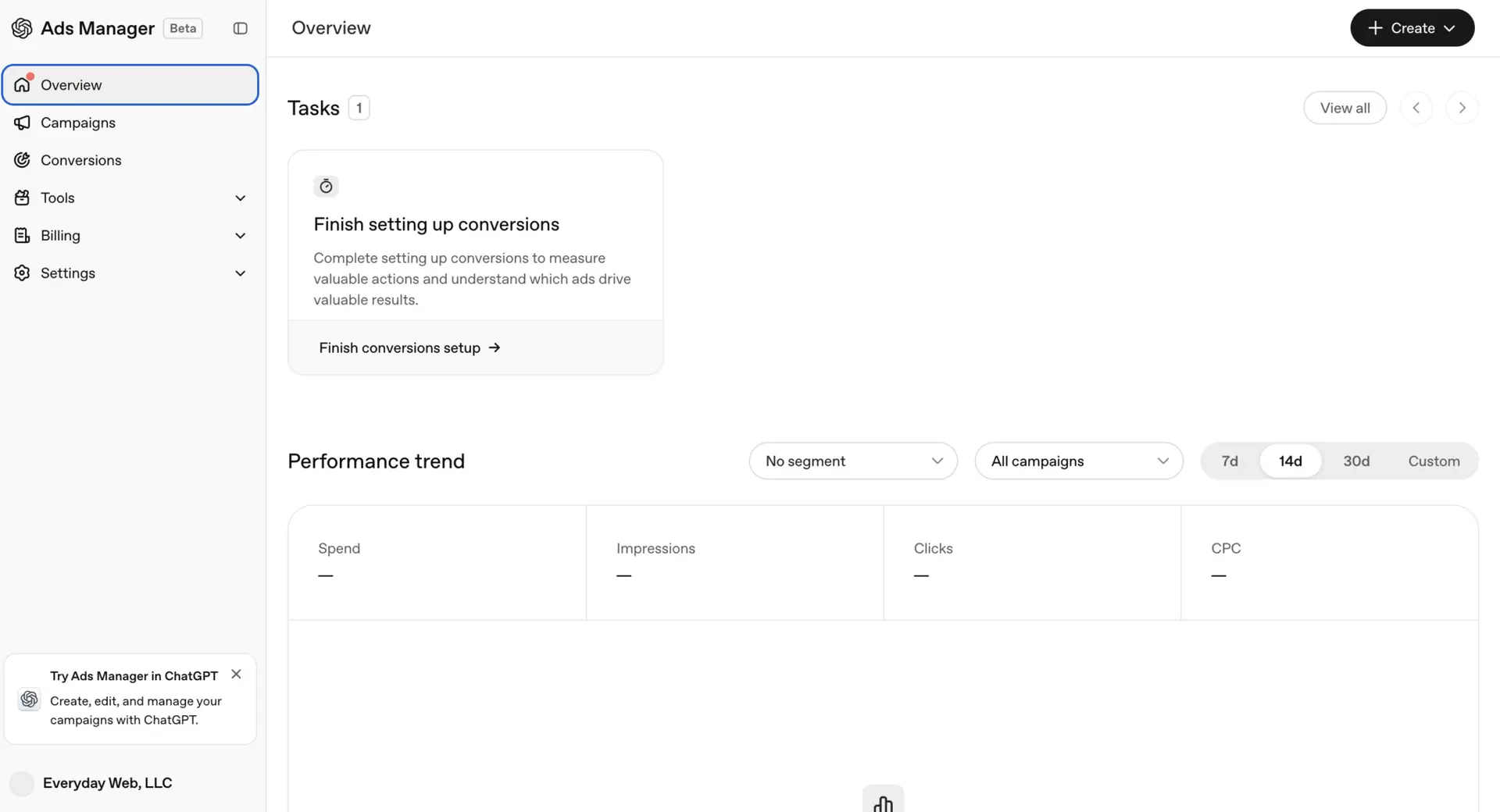
Ads Manager reports metrics including impressions, clicks, spend, average CPC, average CPM, and attributed conversions when measurement is configured. You can also use tracking parameters in your landing-page URLs to help review traffic in your existing analytics tools.
To understand whether the campaign is working, compare spend with the result you actually care about. For example, if a campaign spends $175 and reports five attributed purchases, the reported cost per purchase is $35. That’s an example, not a benchmark or a prediction of your results.
Attribution matters. Depending on your reporting settings, a conversion total can include actions following an ad click and eligible actions following an ad view. An attributed conversion is not necessarily a sale the ad caused on its own. Use comparable attribution windows when evaluating ChatGPT ads against other channels, and check that your tracking is working before making decisions.
Who should run ChatGPT ads?
ChatGPT ads are worth testing for businesses that can reach customers in an eligible market, offer a policy-compliant product or service, and measure whether the traffic produces valuable results. They may be a good fit when customers spend time comparing options before deciding what to buy.
For example, an ecommerce brand might test product ads for a popular category, a local service business might test relevant service inquiries, and a travel company might reach people exploring trip options. The opportunity depends on the audience, offer, location, and campaign economics—not just the fact that people use ChatGPT.
A strong candidate has a clear offer, a useful landing page, and enough budget to run a meaningful test. It also knows what a customer is worth and can track purchases or leads. If your margin can’t support the cost of acquiring a customer, a cheap-looking click alone won’t make the campaign profitable.
It may be better to wait if your business cannot measure outcomes, needs guaranteed acquisition costs, or serves an audience that isn’t available through the platform. Review OpenAI’s ad policies first: some categories are prohibited, while financial, health, and legal services have restrictions or require additional approval.
OpenAI announced availability across 89 countries on October 21, 2026. Self-service access depends on where the advertising and billing entity is based, so check the current country list before planning a campaign.
How do you start advertising on ChatGPT?
To start, create an account at ads.openai.com, confirm your eligibility, and build a campaign in Ads Manager. You’ll need to add billing information, choose a goal and budget, create your ad group and creative, and submit the campaign for review.
If purchases or leads are your goal, set up and test conversion tracking before launch. Then monitor spend and results over enough time to make a useful comparison. Conversion reporting can take 24–48 hours to appear, and spend reporting may also lag, so avoid judging a campaign solely on its first few hours of data.
Finally, remember that a ChatGPT ad and an organic mention in a ChatGPT answer are different things. An ad buys a chance at a labeled placement; it does not buy a recommendation in ChatGPT’s answer.
We’ll be running ChatGPT Ads ourselves so follow our blog for more updates!
References
[2] OpenAI ads in ChatGPT basics
[3] OpenAI conversion-optimized campaigns
[4] OpenAI Maximize Results bid strategy
[5] OpenAI developer guide to bidding and budgets
[6] OpenAI ChatGPT ads availability expansion
[7] OpenAI Ads Manager availability